
The City of Worthington's recently adopted workforce housing property tax abatement program took center stage at the February 12, 2026 Architectural Review Board and Municipal Planning Commission meeting, as Assistant City Manager and Economic Development Director David McCorkle walked board members through the program's goals, eligibility requirements, and safeguards.
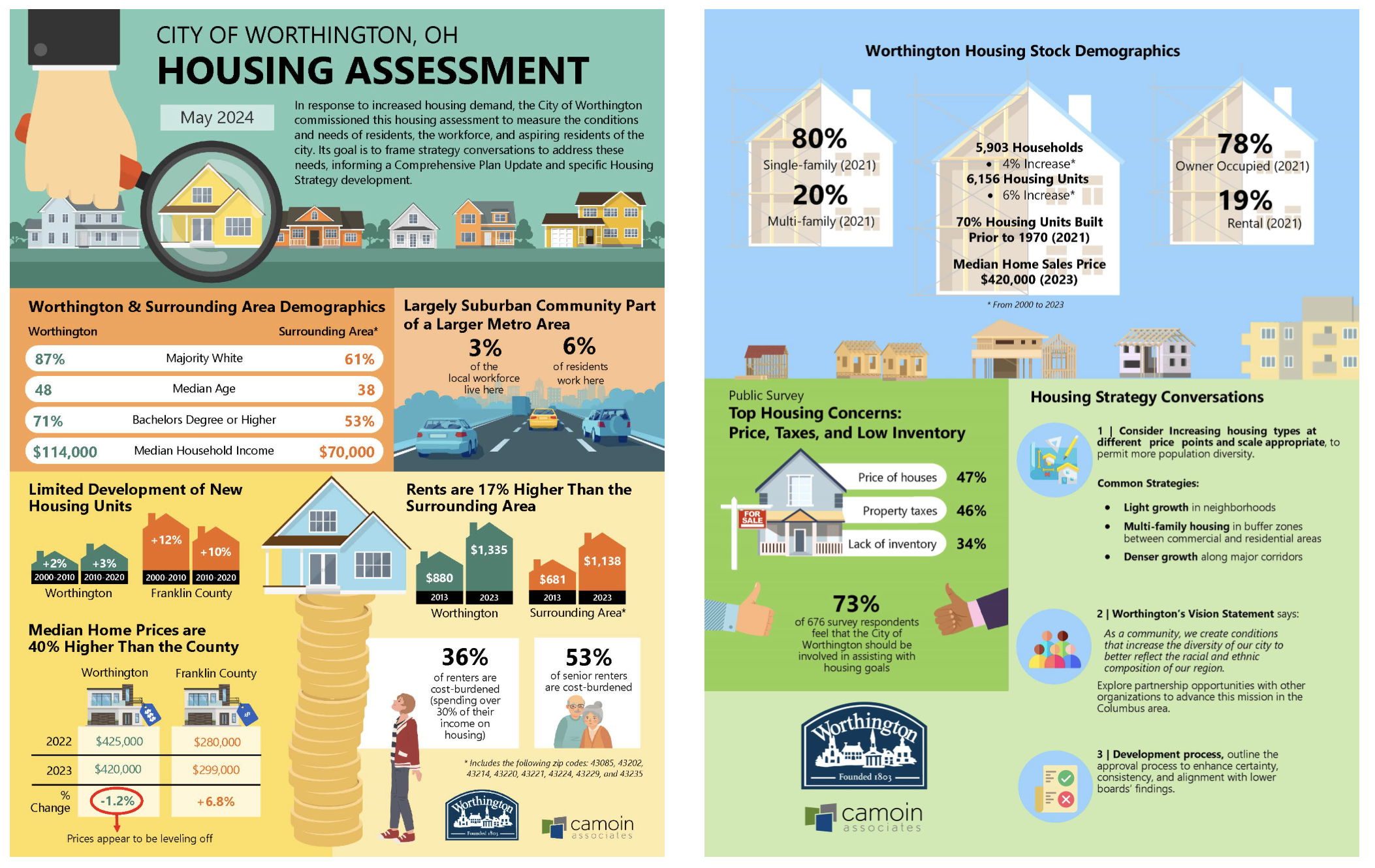
See the city's Housing Assessment Page for more info on the above graphic
Years in the Making
The program grew out of the city's 2020 visioning process, which identified housing as a core priority. McCorkle cited several vision statements guiding the effort, including commitments to "quality housing services and amenities for all residents" and promoting "a stable and diverse housing market" that allows residents to "put down roots" in the community.
City Council held multiple discussions about housing tools during summer 2025 before approving the workforce housing program in December 2025.
Why "Workforce" Housing?
The city deliberately chose the term "workforce housing" rather than "affordable housing" to signal the program's dual purpose. "This community leans heavily on income tax revenue collection. We are funded — three quarters of our budget comes from payroll taxes," McCorkle explained. The program is designed to serve both affordability goals and economic development by requiring participating developments to generate payroll alongside housing units.
McCorkle noted that the city's top employers consistently say they need housing options nearby to attract and retain workers.
Setting Realistic Targets
A housing assessment by Camoin Associates found demand for 2,000 additional housing units in Worthington — a striking figure given the city's current stock of roughly 6,000 units. Rather than pursue that full figure, the city calculated its proportional share of regional housing goals.
The Columbus region has targeted 200,000 new housing units, with the City of Columbus committing to 100,000 and looking to regional partners for the remaining 100,000. Worthington's population-based share of that total came to 1,300 units. "City Council has committed to pausing the program when we reach that target and reevaluating," McCorkle said.
Program Specifics
The program targets new construction of mixed-use, multifamily developments — not single-family homes. Key eligibility requirements include:
- Projects under 2 acres: Minimum $2 million in payroll and at least 4 housing units
- Projects over 2 acres: Minimum $5 million in payroll and at least 10 housing units
The geographic boundaries mirror the city's existing commercial abatement program, covering commercial corridors including High Street, Wilson Bridge Road, Worthington-Galena Road, and Huntley Road. Single-family residential neighborhoods (R10 zones) are not eligible.
Affordability Standards
The city settled on 60% and 80% of Area Median Income (AMI) as the appropriate affordability levels, based on federal HUD guidelines for the Columbus region:
- 60% AMI: Household income of roughly $45,000–$65,000/year (for 1-4 person households)
- 80% AMI: Household income of roughly $61,000–$87,000/year (for 1-4 person households)
"Your teachers, your government workers. What we have learned through conversations with the development community is these are where the workforce are," McCorkle said.
Housing costs for qualifying tenants would be capped at no more than 30% of total income, inclusive of utilities.
Abatement Structure
Developers must commit a minimum of 20% of units as workforce housing. They can commit up to 30% of units and choose between 60% and 80% AMI levels. In exchange, the city abates property taxes on the incremental value created by new construction — that is, the difference between the pre-development land value and the value of the completed project.
Abatements range from 50% to 100% for a base period of 10 years. Developers can earn bonus years (up to the state statutory maximum of 15 years) for every $5 million of additional payroll created beyond the minimum threshold.
The city is also exploring a step-down approach in later years to avoid "sticker shock" when abatements expire. "If they had 100% abatement, they're not paying taxes, and then all of a sudden in year 11, they have the full freight of the property taxes, that could potentially significantly impact the project in a negative way," McCorkle cautioned. The concern is particularly acute for residential tenants, as property tax increases would likely be passed through as rent increases.
Blended, Not Segregated
One feature McCorkle highlighted: workforce housing units must be blended throughout developments, not concentrated in one area. The affordability must also be distributed proportionally across unit types. "If we have a development that comes in and 60% of the units are one bedroom, 30% are two bedroom and 10% are three bedroom, the affordability will also be spread and dispersed amongst the one bedroom, two bedroom and three bedroom," he explained.
All workforce housing residents will have access to the same amenities as market-rate residents.
Oversight and Accountability
The city's existing Tax Incentive Review Council will oversee the program through annual reviews. McCorkle noted the city has used its commercial abatement program sparingly — just six abatements in 20 years — and plans to apply similar discipline to the workforce housing program.
Recipients must report annually on affordable unit counts, AMI levels, payroll, and jobs. The review council has the authority to modify or terminate any abatement that fails to meet its commitments.
Potential Early Applicants
McCorkle identified three locations where the city's new "workforce housing" tax abatement program could first be used: the Crawford Hoying development on West Wilson Bridge Road, the Anthem property, and the site directly across from Crawford Hoying.
Because the program requires projects to generate significant tax revenue through jobs as well as housing, McCorkle clarified that the Elford residential project would not qualify on its own. However, it could become eligible if Elford partners with the nonprofit Boundless. As one of Worthington's top 10 employers, a commitment from Boundless to keep and grow its workforce at that location would provide the necessary payroll tax base to meet the program's requirements.
School District Impact
Board member Susan Hinz raised the question of how new housing units would affect the school district. McCorkle reported that the school district has described its student growth as "stable" and that data from comparable developments is reassuring.
Planning & Building Director R. Lee Brown offered a concrete example: when the Heights at Worthington Place opened with 193 units, only five students initially enrolled in the district — two were net new, while three were already in the system. That number has fluctuated to a maximum of 10-12 students.
McCorkle added that current projects are targeting predominantly one- and two-bedroom units (roughly 90%), with only about 10% three-bedroom, which limits the number of school-age children.
After the formal presentation, McCorkle provided additional context: the standard housing multiplier for apartments is 0.21 students per unit, and that the tax revenue generated by developments like the Heights and the District at Linworth — which have each seen a maximum of about 15 students — "far exceeds" the cost to serve those students, representing "a positive gain from a financial perspective".